
SUGGESTED RESULTS
THERE ARE NO SUGGESTED RESULTS
Heimo Zobernig (Mauthen, Austria, 1958)
Untitled
2009
WORK INFORMATION
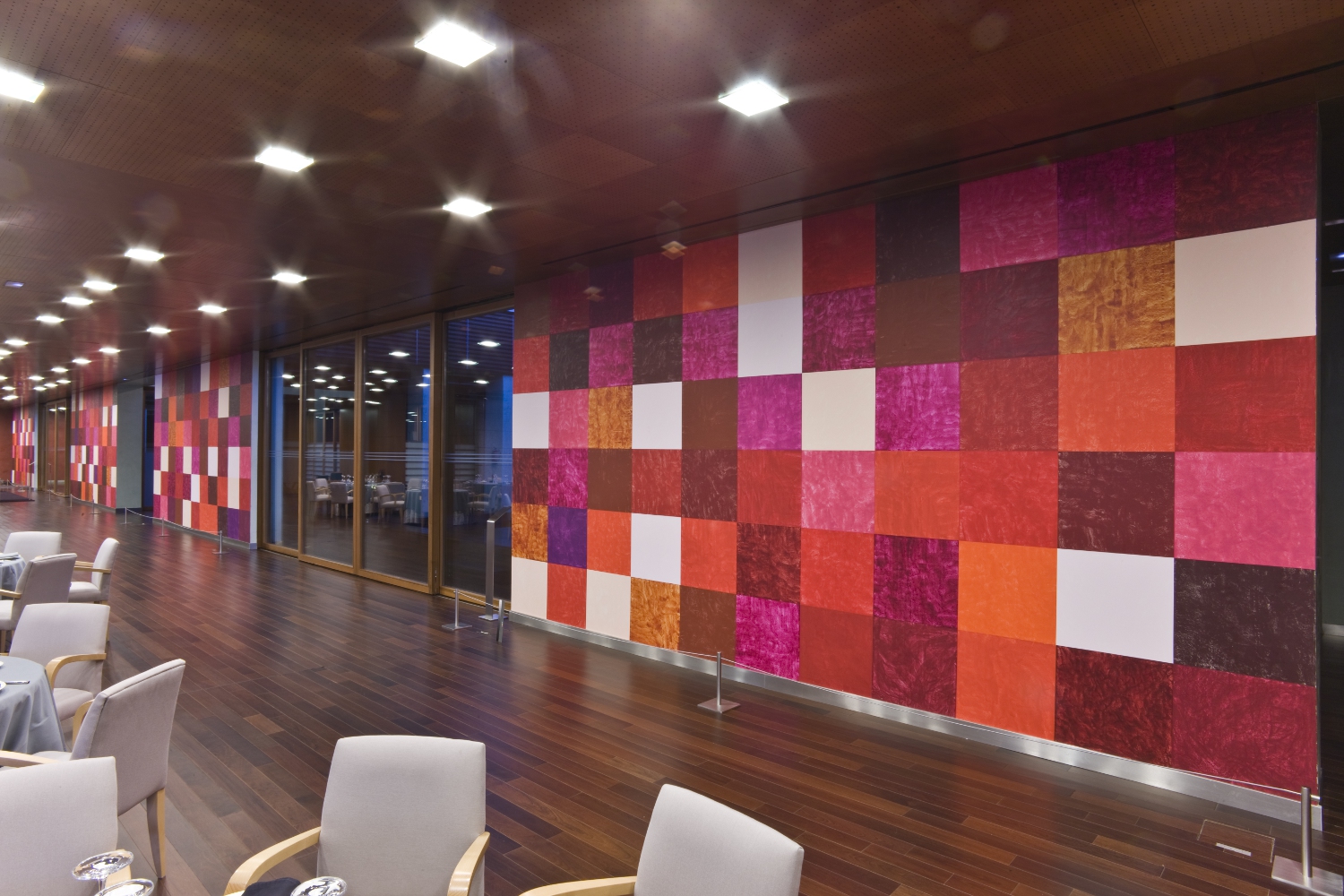
Acrylic on four plasterboard panels, 320 x 595 cm each (4 pieces)
Since the beginning of his creative career in the early 1980s, Austrian artist Heimo Zobernig has wielded disciplines on the fringe of traditional visual arts, such as graphic and stage design, with the same audacity applied to revising and appropriating languages inherited from abstraction, minimalism, Russian Constructivism and De Stijl, with the ultimate aim of challenging conceptual positions on the creation and exhibition of art.
Towards the end of the first decade of the new century, Zobernig created this untitled work to trigger a critical reassessment of established artistic premises, using colour as the essential element in terms of how it is arranged by the artist and how it is perceived by the audience. Drawing on his knowledge of theatre, he took four large plasterboard panels and drew a regular grid of sixty-six squares on each one, filling the squares with different shades of red and leaving some blank to attenuate the chromatic hues.
This work is the visual materialisation of a line of research that Zobernig began in his books Die Kunst der Enzyklopädie (1988) and Lexikon der Kunst (1992), theoretical essays that question the legitimacy of encyclopaedic manuals. His early interest in this question later led to studies of colour, whose presumed objectivity is confronted with the writer Ferdinand Schmatz in their co-authored book Farbenlehre, published for the artist's books section sponsored by Kasper König at the 1995 Frankfurt Book Fair. That compendium contains various reflections on colour expressed by philosophers, educators, physicists and artists from Antiquity to the present day, concluding that there is no such thing as an indubitable truth of colour.
As if conducting a taxonomic experiment, here Zobernig uses the spatula to apply as many as twenty-six different shades of Lascaux-brand red using pure, unmixed pigments straight from the package. These colour substances have different physical and chemical properties that determine the tone, saturation, transparency, luminosity, gloss, reflectivity and surface of the panel, allowing the artist to obtain a non-idealised chromatic spectrum of crimson, vermilion, orange, blue and brown hints. The result is an organised expression of a colour system. Delegating responsibility to this objective structure, Zobernig is free to express himself subjectively, moving on the limits of categorical statements—in this case, the colour red—to conclude with the resulting impossibility of establishing objective values; artistic perception is translated into an individual experience. In line with this action, which reminds us of a theatrical illusion or a counterfeit encyclopaedic repertoire, Zobernig takes the opportunity to reflect on his multiple facets as an artist, set designer and scientist, applying the theoretical ambiguity he suggests to the very concept of creative authorship. [Almudena Cruz Yabar]