

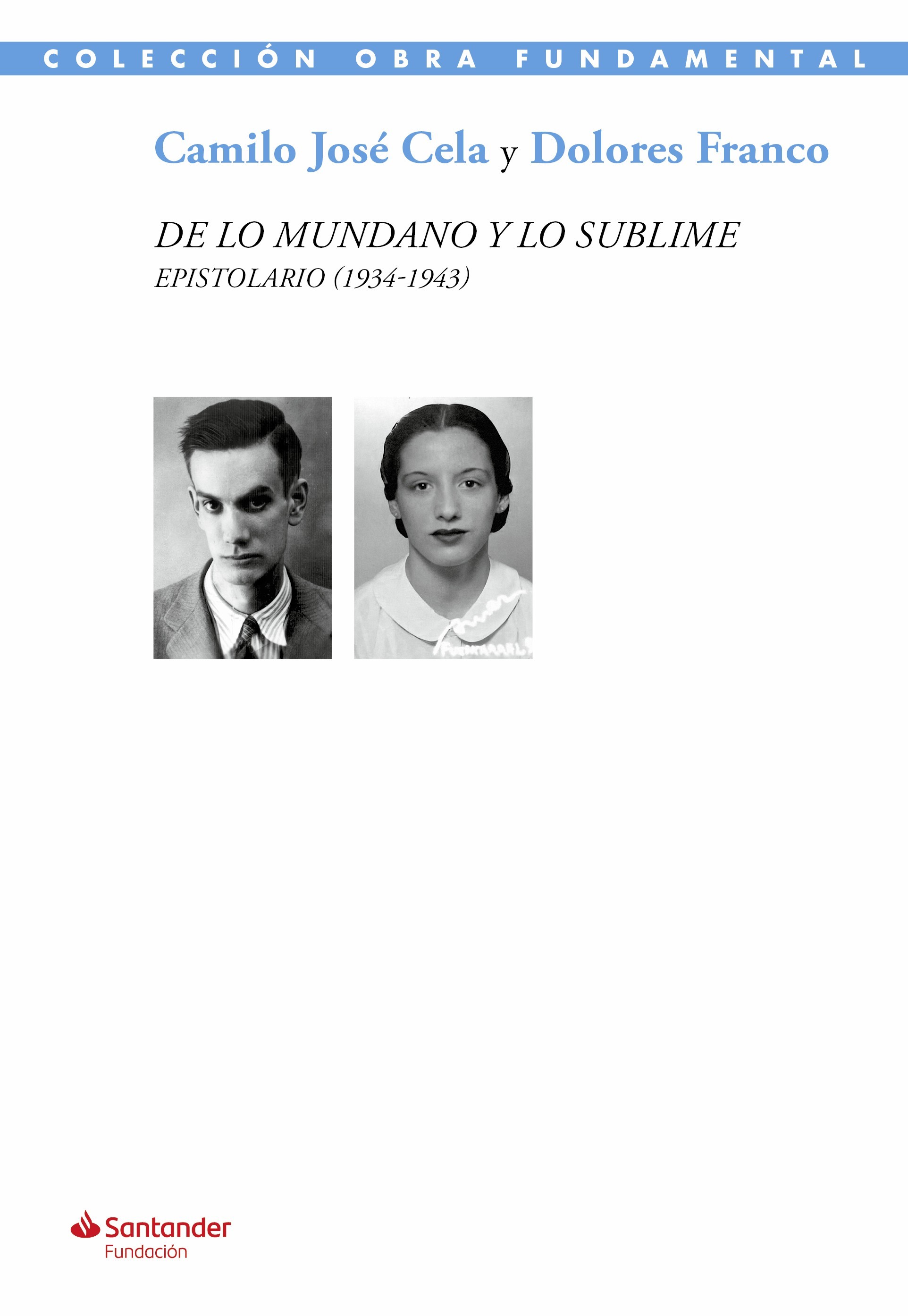
Lolita Franco (1912–1977) and Camilo José Cela (1916–2002) maintained a correspondence between 1934 and 1943 that brings us closer to the forgotten personality of the woman who would later become Julián Marías’s wife, as well as to the formative years of a writer who, under the anxious influence of Pablo Neruda, Rafael Alberti, and Vicente Aleixandre, aspired during those years to become a poet. Their letters, exchanged during the final two years of the Second Republic, continued throughout the Civil War and the immediate postwar period. Beyond their literary dimension, reading them reveals the vital pulse of “an exceptional woman, intelligent, cultured, and sensitive, clear-headed and noble and serene in feeling” (as Cela describes her in his memoir Memorias, entendimientos y voluntades, published in 1993), alongside the intensity of the painful formative process of the future novelist and Nobel Prize laureate, as evidenced in his first book, Pisando la dudosa luz del día. Poemas de una adolescencia cruel, written in the autumn of 1936 in Madrid.
In light of this correspondence, Lolita Franco—an outstanding student of the prodigious Faculty of Philosophy and Letters at the University of Madrid (Ortega y Gasset tried to persuade her to become the first woman to earn a degree in Philosophy)—guides Camilo José’s steps, advises him on his creative successes and failures, encourages him to read Ortega, and urges him to get in touch with Pedro Salinas or María Zambrano, while in the young poet a palpable infatuation grows, evident in the letters from the years 1935–36.
Moving between the worldly and the sublime, this unique collection of letters reveals not only the personality and figure of Lolita Franco—intellectual, teacher, and translator—but also an unknown and still insecure Cela taking his first vital and literary steps.
ADOLFO SOTELO VÁZQUEZ is Professor of Spanish Literature at the University of Barcelona, Director of the Camilo José Cela Chair of Hispanic Studies at UCJC in Madrid, and literary critic for La Vanguardia. Among his works are the books Perfiles de Clarín (2002), Viajeros en Barcelona (2005), De Cataluña y España. Relaciones culturales y literarias (1868–1960) (2014), Variaciones Cela (2018), and Fragmentos (2024). He has also edited works by Juan Valera, Francisco Giner de los Ríos, Benito Pérez Galdós, Leopoldo Alas, Emilia Pardo Bazán, Miguel de Unamuno, Américo Castro, Carmen Martín Gaite, and Camilo José Cela. Of the latter, he also edited La forja de un escritor in Cuadernos de Obra Fundamental (2016).
