
SUGGESTED RESULTS
THERE ARE NO SUGGESTED RESULTS
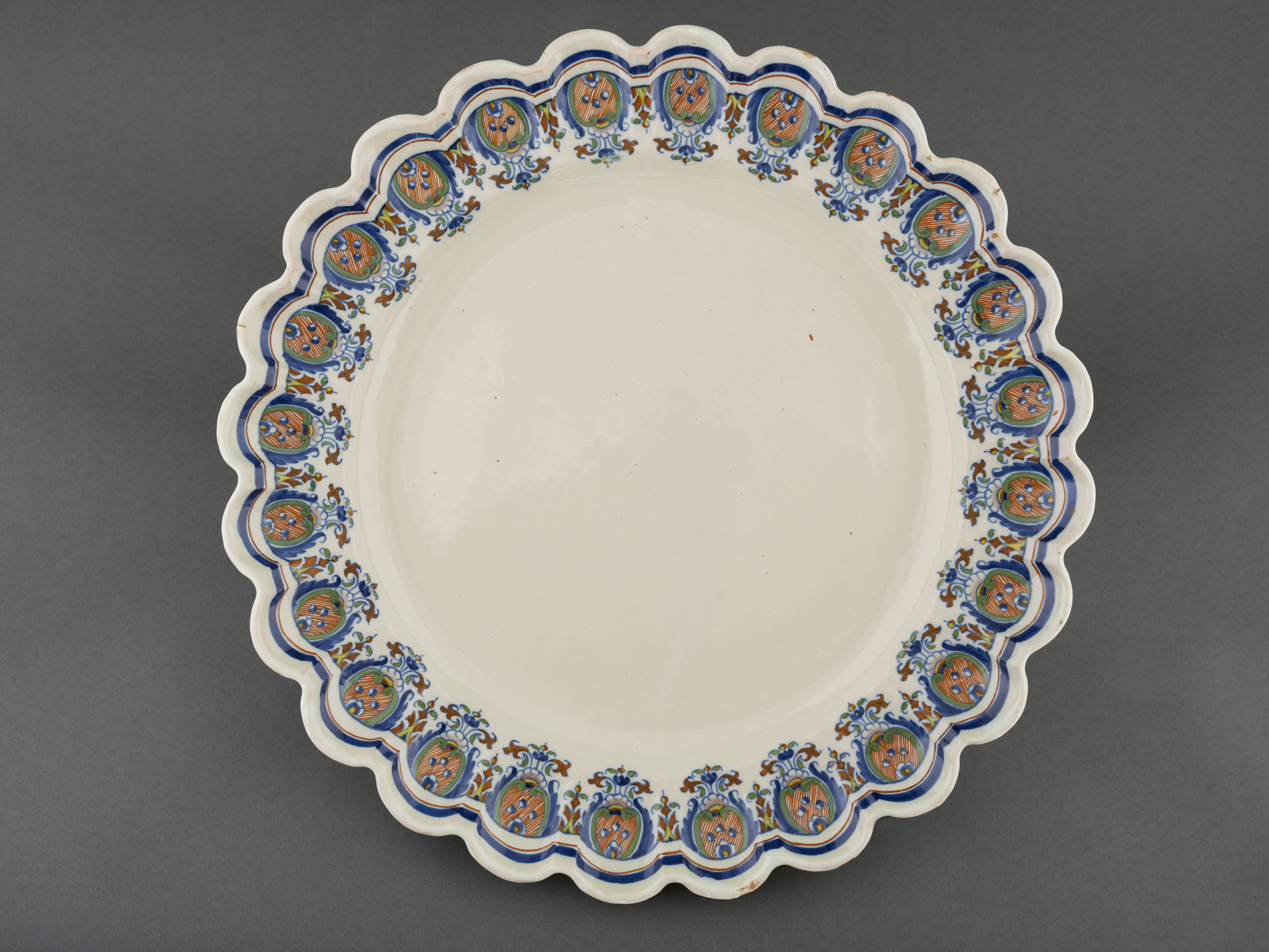
Manufactura de Alcora
Dish
Rouen-influence series (1740-1750)
WORK INFORMATION
Ceramic, blue- and red-decorated earthenware, diam. 44 cm
The Alcora manufactory was founded in 1727 by the 9th Count of Aranda on land he owned in what is now the province of Castellón. The aim was to create a luxury earthenware and porcelain factory that would compete with foreign manufactories. Royal privileges, including tax exemption on the export of pieces and the free entry of materials from abroad, allowed this manufactory to operate until the middle of the 19th century despite the fact that it barely made any profits.
Throughout its existence, the factory became a model of organisation and a point of reference in terms of aesthetics thanks to the recruitment of foreign specialists, artists and “secretists” who claimed to know the secret of porcelain manufacture. In addition, the creation of an apprentice academy enabled the manufactory to continue to provide top quality production.
This circular dish with a gadrooned brim features an elegant lambrequin border in blue and red that stands out against the white background. The ornamental motif originates from Chinese porcelain of the Kangxi period (1622-1722), known in Europe through the imports of the East India Company. From the 18th century onwards, it appeared in the marquetry of the cabinetmaker and decorator André-Charles Boulle (1642-1732), in leather embossing, in damasks, in silversmithing and goldsmithery work, in garden design and in the ceramics of Rouen, Moustiers, Delft and Alcora. The Alcora manufactory adopted this motif between 1733 and 1750 under the influence of the Rouen potteries. Applied on the rim of the pieces, at Alcora it was always reproduced in blue or in blue and red.